
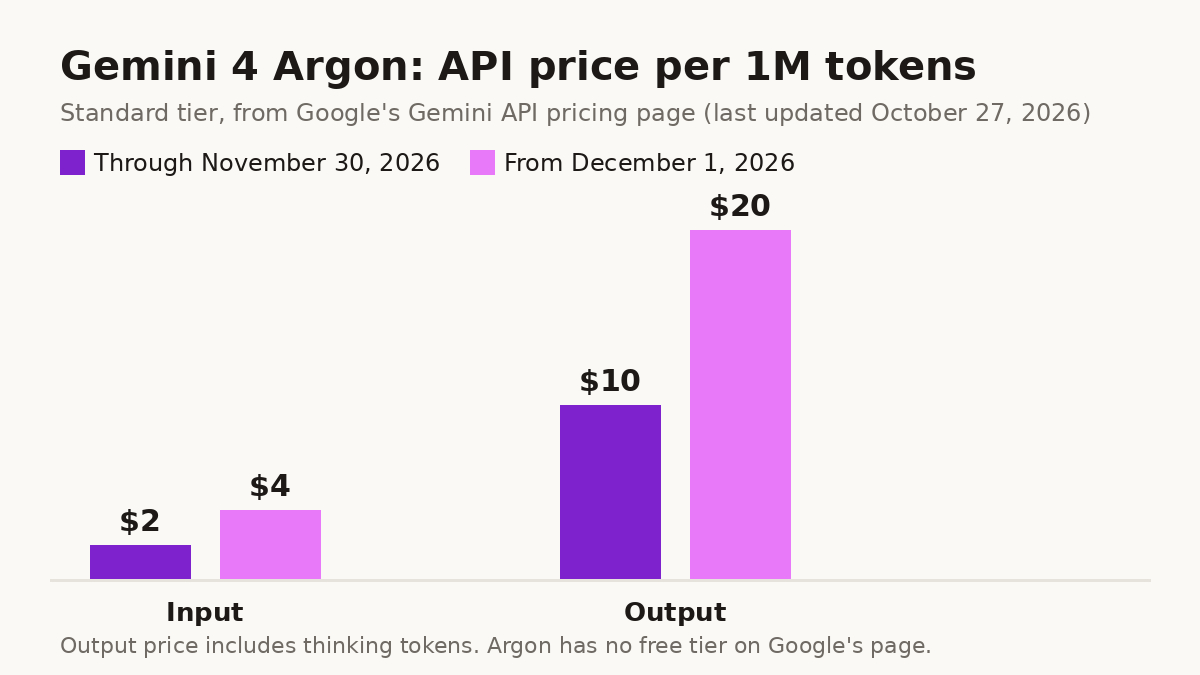
Google did something vendors rarely do: it printed a price rise in advance, on the pricing page itself. Gemini 4 Argon, the flagship reasoning model Google launched on October 13, 2026, costs $2 per million input tokens and $10 per million output tokens through November 30, 2026. From December 1, 2026, the same page lists $4 and $20. Nothing about the model changes that morning. Only the number does. One boundary before the math: these are API prices, charged per token to people building on the model. They are not the Gemini subscription prices in our subscription price comparison, and nothing in that comparison moves on December 1.
1. Two prices, printed side by side
The schedule sits in the Standard tier table on Google's Gemini API pricing page, which Google last updated on October 27, 2026. Input tokens: $2.00 through November 30, then $4.00 starting December 1. Output tokens, thinking tokens included: $10.00, then $20.00. The supporting prices move with them. Context caching doubles from $0.10 to $0.20 per million tokens, and the discounted Batch tier goes from $1 and $5 to $2 and $10, which makes Argon's December batch price the same as its standard price today. Every mode on the page tells the same story: the introductory window closes on November 30, and December pricing is exactly double.
Google gives the first set of numbers no special name on the page, but the structure is an introductory offer with a printed end date. That is worth more than a launch post, because a pricing page is the document budgets and contracts get written against.
2. The comparison flips on December 1
At $2 and $10, Argon sits exactly on the list price of OpenAI's GPT-6.1 Sol, which OpenAI's API pricing page lists at $2.00 input and $10.00 output per million tokens, and at half the price of Anthropic's Claude Opus 5.5, listed in Anthropic's pricing docs at $4 input and $20 output. On December 1, Argon moves up to meet Opus 5.5 line for line at $4 and $20, and Sol becomes the flagship that costs half as much. GPT-6.1 Terra, at $1 and $5 on OpenAI's page, stays where it is: half of Argon's introductory price, and a quarter of its December price. Every price in this section comes from the three vendors' own pricing pages, read on October 27 and 28, 2026. They are list prices, and list prices say what a model costs. They say nothing about which model earns it.
3. Every October comparison expires that morning
Any cost comparison written in October that priced Argon at $2 and $10 was right when written and is wrong from December 1, including roundups that ranked Argon as tied for the cheapest flagship. The tell is a missing date: an Argon price quoted without an as-of line is either the introductory number or an error, and after November 30 those are the same thing. Our own position is easier to state. The comparison dataset behind this site holds 210 head-to-head matchups and predates Argon's October launch, so no record in it mentions the model and no verdict here quietly expires. What does expire is any budget, spreadsheet or shortlist that copied the October number forward into 2027.
4. November math: test at the low price, budget at the high one
Take a support agent that burns through 40 million input tokens and 10 million output tokens a month. At the introductory price: 40 times $2 is $80 of input, 10 times $10 is $100 of output, $180 a month in total. From December 1: 40 times $4 is $160, 10 times $20 is $200, $360 a month. The workload did not change; the bill doubled, and across 2027 the gap adds up to $2,160. So November is the cheapest evaluation window Argon will ever have. Run the tests now, while the meter runs at half price, and write every 2027 budget line at $4 and $20. A plan that carries $2 and $10 into next year is not optimistic. It is wrong by a factor of two.
5. There is no free tier to fall back on
One more line from Google's page matters to readers of this site: in the free tier column, Argon reads "Not available" in every mode. There is no free allocation to keep testing with once a paid evaluation ends, and no free tier to catch a workload nobody budgeted for. That absence is the question our free FreeTier Finder exists to answer for the tools in our dataset: which ones record a real free tier, and which record none, with two free runs a day before the email prompt. Its short explainer sets out the ranking rule. Argon is not in that dataset, so the Finder returns no verdict on it. Google's own page already has.
6. If you pay for a subscription, none of this is your bill
Most readers of this site do not buy tokens. If your AI spending is a monthly subscription, December 1 changes nothing for you: ChatGPT Plus, Claude Pro and Gemini Advanced keep the prices compared in our flagship price comparison, and for research work the live question stays the one in Perplexity vs ChatGPT. The Argon doubling lands on builders and on the teams who budget their usage, and for them the whole story fits in one line: the price you test at in November is not the price you will pay in 2027.